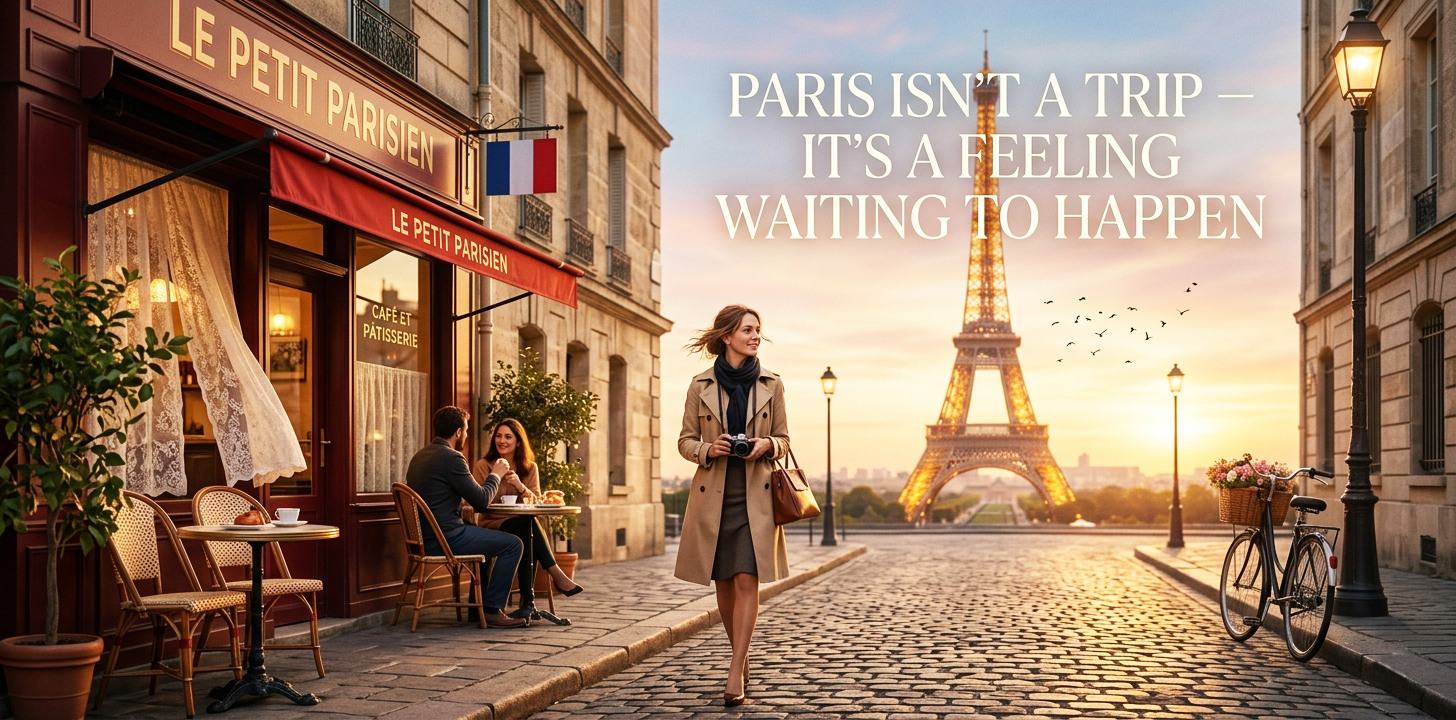
Every traveller hears about Paris. Few understand it. Here’s why the French capital doesn’t just reward visits — it inhabits you long after you’ve left.
There’s a particular kind of sadness that only comes from leaving Paris. Not the sadness of a holiday ending — you’ve felt that before. This is different: a low, persisting ache, as if the city pressed a faint watermark into your chest and you only notice it when you’re gone. Paris does not merely attract visitors. It imprints itself.
Millions of travellers arrive every year expecting monuments. They get the Eiffel Tower, the Louvre, the macarons. But somewhere between a second glass of Côtes du Rhône at a zinc-topped bar and the golden afternoon light bouncing off the Seine, something quietly shifts. The trip stops being a trip. It becomes a before-and-after.
“To know Paris is to know a great deal.”
— Henry Miller, novelist & long-time Paris resident
Why does Paris feel different from every other city?
Part of the answer is architectural — Paris was largely rebuilt in the mid-19th century under Baron Haussmann, creating the uniform limestone facades, wide boulevards, and iron balconies that make every arrondissement feel like a film set waiting to roll. The city is internally consistent in a way almost no major capital is. Walk from the Marais to Saint-Germain and the visual language barely changes. That coherence has a cumulative, sedating effect.
But the deeper answer is sensory. Paris layers pleasure so densely that the brain eventually stops cataloguing and starts simply feeling. The smell of butter in a boulangerie at 7am. The sound of a jazz quartet drifting from an open cellar in the Latin Quarter. The weight of a café crème cup in your palm at a terrace table while the city performs its morning routine around you. These are not “experiences” — they’re a texture. And texture, unlike attractions, is nearly impossible to prepare for or to exhaust.
THE GEOGRAPHY OF FEELING
Paris is divided into 20 arrondissements arranged in a clockwise spiral from the centre. Each one carries its own character, and experienced travellers will tell you that falling in love with Paris often means falling in love with one specific neighbourhood — not the whole city, but a particular stretch of it.
Paris Neighbourhood Guide
| ARRONDISSEMENT | CHARACTER | BEST FOR | VIBE |
| Le Marais (3rd & 4th) | Medieval lanes, galleries, LGBTQ+ hub, Jewish quarter | Art, food, nightlife | Art & Culture |
| Saint-Germain (6th) | Literary cafés, antique dealers, Jardin du Luxembourg | Slow mornings, bookshops | Classic Paris |
| Montmartre (18th) | Hilltop village, artists, sweeping views | Sunsets, atmosphere | Romantic |
| Oberkampf (11th) | Local bars, natural wine, zero tourists | Authentic Paris nights | Foodie / Local |
| Ile Saint-Louis | Quiet island, 17th-c. mansions, Berthillon ice cream | Tranquility, gelato walks | Serene |
What to actually do in Paris (beyond the obvious)
The Eiffel Tower is worth seeing once — ideally from a distance, from the Trocadéro or the Champ de Mars at dusk, with something cold to drink. The Louvre is genuinely overwhelming and best done in a single-room deep-dive rather than a sprint through all 35,000 exhibits. The Notre-Dame, now restored after the devastating 2019 fire, is once again one of the most stirring pieces of Gothic architecture in the world.
But the lasting Paris is found elsewhere. It’s found at the Musée de l’Orangerie, standing inside Monet’s oval Nymphéas rooms, where two enormous curved paintings wrap the space like a living panorama. It’s found at Shakespeare and Company, the legendary English-language bookshop on the Left Bank. It’s found on a Sunday morning at the Marché d’Aligre, Paris’s most local market, where you’ll find zero guidebook crowds.
| LOCAL TIP Buy a carnet (book of 10 metro tickets) on day one. Walk everywhere within 20 minutes of your destination — Paris’s street-level detail rewards pedestrians far more than it rewards commuters. The best things you’ll find won’t be on any map. |
THE FOOD QUESTION
Eating well in Paris is not difficult. It is, however, a discipline. The tourist traps congregate tightly around Notre-Dame, the Champs-Élysées, and Montmartre’s summit. Fifteen minutes on foot in almost any direction opens an entirely different register: neighbourhood bistros with handwritten chalkboard menus, €14 lunch formules, and wine by the carafe.
The contemporary Paris food scene runs on small bistronomie restaurants: chef-driven, unfussy, technically precise. Neighbourhoods to target: the Canal Saint-Martin area (10th), Pigalle, and the stretch along Rue du Faubourg Saint-Denis. Book in advance. Show up exactly on time. Surrender the evening.
· · ·
When to visit Paris: the honest guide
Paris is a year-round city, but the experience varies significantly by season. Here is an honest breakdown — not the marketing version.
| BEST OVERALL Spring Late March–May. Cherry blossoms, mild weather, terraces reopen. | RUNNER-UP Autumn Sept–Nov. Crowds thin, golden light, fashion weeks energise the city. | WORTH KNOWING Summer July–Aug. Hot, crowded, but magical near the Seine at night. | UNDERRATED Winter Dec–Feb. Grey and raw — museums are quiet, Christmas lights extraordinary. |
How many days do you need in Paris?
Three days will let you cover the major sites and eat well twice. Five days will let the city begin to feel familiar — you’ll have a regular café, a neighbourhood that feels like yours. Seven days or more and you stop sightseeing altogether. You start living there, which is arguably the whole point.
The most honest answer: however long you go for, it won’t be enough. Budget accordingly, both in time and in expectation. Paris is one of the few places in the world where returning — whether in three years or thirty — still feels like arriving for the first time.
· · ·
FREQUENTLY ASKED QUESTIONS
Is Paris worth visiting in 2026?
Absolutely. Paris remains one of the world’s most complete city experiences — combining world-class art, architecture, food, and a street-level atmosphere unmatched almost anywhere. Post-Olympics infrastructure improvements and the reopened Notre-Dame cathedral make 2026 a particularly rewarding year to visit.
What is the best area to stay in Paris for first-time visitors?
The Marais (3rd/4th arrondissement) and Saint-Germain-des-Prés (6th) are both excellent bases: central, walkable, and full of neighbourhood character. Avoid staying directly on the Champs-Élysées — it’s expensive and impersonal compared to the Left Bank or the historic heart of the city.
How much does a trip to Paris typically cost?
Budget roughly €150–200 per day per person at a mid-range level, including accommodation, meals at proper restaurants, transport, and one paid museum per day. Paris rewards careful planning: the metro is cheap, many museums offer free first-Sunday entry, and picnic lunches from a boulangerie and fromagerie are both affordable and deeply Parisian.
Do Parisians speak English?
Most younger Parisians and hospitality workers speak English comfortably. A few words of French — bonjour, merci, s’il vous plaît — go a disproportionately long way. The cliché of rude Parisians largely dissolves when visitors lead with basic French pleasantries; the city responds with warmth.
What is the best time of year to visit Paris?
Late spring (April–May) and early autumn (September–October) offer the best combination of weather, lower crowds, and peak Parisian atmosphere. Spring brings blossom and blooming terraces; autumn brings golden light, fashion week energy, and a return of the city to its residents after the summer exodus.
Is Paris safe for solo travellers?
Paris is generally very safe for solo travellers, including solo women. As in any major city, standard precautions apply: stay aware in crowded tourist areas where pickpocketing is common, keep bags secure, and use well-lit metro stations late at night. The city’s café culture makes solo travel particularly rewarding — a book and a table at a terrace is as natural here as anywhere on earth.
· · ·
The feeling, in the end
Ask anyone who has been and really paid attention. Ask them about the moment Paris stopped being a destination and became something else. It might have been the light on the Seine at six in the evening. A stranger’s laugh in the courtyard below their apartment window. The particular silence of a Parisian museum an hour before closing when the crowds have thinned and you are alone with something extraordinary.
They’ll pause before answering — not because they can’t remember, but because they’re back there for a second. That pause is the whole argument. Paris is not a trip. It’s a feeling waiting to happen to you — and once it does, it keeps happening, in memory, in longing, in the quiet certainty that you’ll return.
© 2026 Piyo Cab. All rights reserved. www.piyocab.com
Leave a Reply